
A mixed-age ambiance
The class — known as an « ambiance » — brings together children aged 3 to 6. The environment naturally fosters exchange, experimentation and mutual help.
Children's House
The 3-6 class — the Children's House — is designed around each child's natural rhythm. A carefully prepared environment, a complete set of sensorial materials, and a Montessori-trained teacher with an assistant, one of whom is a native English speaker.
Up to 25 children per class, mixed across three age levels — for mutual help, peer teaching and natural emulation.
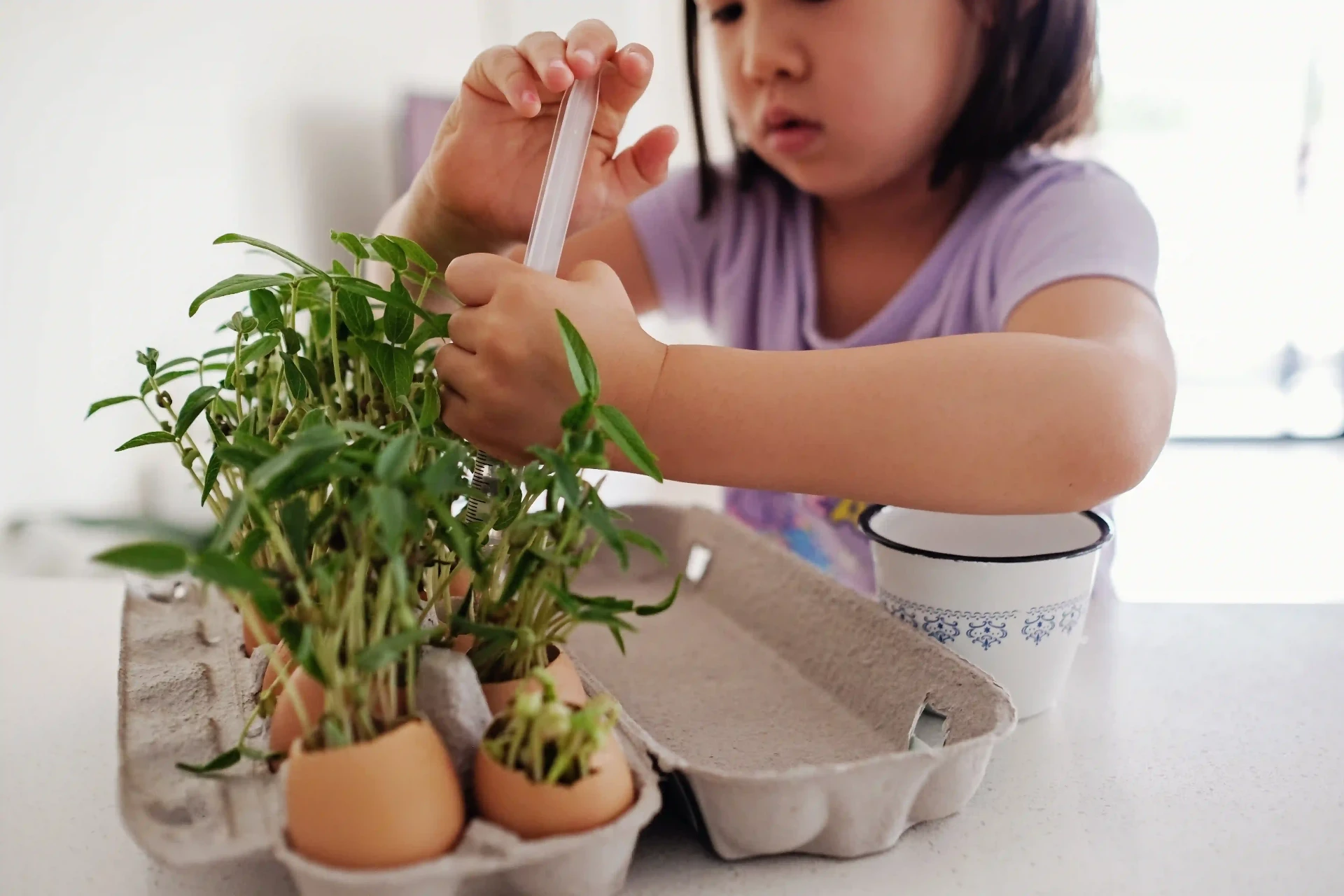
The class — known as an « ambiance » — brings together children aged 3 to 6. The environment naturally fosters exchange, experimentation and mutual help.
The Montessori materials are complete: they support each child's development and allow immediate control of error. Working with the materials builds concentration, and in turn helps the child manage their emotions and distractions to stay focused on their work.
Every day, the class gathers for shared moments: rhymes, reading, music, grace-and-courtesy skits and more.
Material presentations and pedagogical follow-up are always individual. The progression is clear and fully aligned with the French national curriculum.
Montessori materials are organised into distinct areas. Each child freely chooses an activity in the area that draws them, at their own pace.
Pouring, transferring, folding, buttoning, caring for plants — everyday activities that build concentration and independence.
Pink tower, brown stair, colour boxes, red rods: refining the senses, indirect preparation for mathematics.
Sandpaper letters, movable alphabet, emerging reading. Everything is handled before it's read or written.
Number rods, golden beads, spindles: a gradual move from concrete quantity to abstract symbol.
Geography, sciences, botany, zoology. Children start discovering the world from the Children's House onwards.
A native English-speaking assistant is present every day. Children hear, understand, then speak.
It's an approach developed by Maria Montessori (Italian physician, 1870-1952) based on observing the child and respecting their rhythm. The child freely chooses their activity in a carefully prepared environment, handles concrete sensorial materials, and moves gradually from sensory experience to abstract thinking. The teacher observes and guides — never imposes.
Yes and no. The educational objectives of the French national curriculum are fully respected, but not the detailed programme itself. We follow the Montessori curriculum, delivered by our trained teachers and assistants.
The aim of Montessori isn't only to prepare a child for the next school — it's to prepare them for life. Our pupils go on to state, private or international schools. They leave with valuable skills: autonomy, organisation, self-confidence, intellectual curiosity and the ability to learn on their own. These qualities usually make the transition to a new school setting smooth.
Multi-age classes (3-6 and 6-12) encourage cooperation, mutual help and healthy emulation. Younger children learn by watching the older ones; older children consolidate their knowledge by passing it on. It's a cornerstone of Montessori education.
Dig deeper
A 15-minute chat with our head teacher, no strings attached. You'll leave with a clear picture of our approach and the next steps.
The 3-6 environment, known as the Children's House, matches the sensitive period for order, language and movement. Children find a space designed for them: furniture at their scale, a full Montessori material set (practical life, sensorial, language, mathematics, culture) and teachers available to introduce each new material individually.
This environment welcomes children from 2.5 years old, including those not yet toilet-trained at the time of enrolment. The mixed-age class (nursery, pre-K and kindergarten) creates a small, caring society where the youngest learn from the oldest, and where entering school feels smooth thanks to a stable reference adult over three years.
English immersion starts from the nursery year, carried daily by an English-speaking teacher or assistant. Children who stay at Junior Academy enter Year 1 already reading, writing, doing first operations and speaking spontaneous English.