In the morning
"Good morning! How are you today?" Greetings, the day's ritual, the calendar — all in English. The child hears, replies, absorbs.
Bilingual immersion
At Junior Academy, English isn't a subject on the timetable — it's the language you ask for help in, sing in, share a snack in, read a picture book in. A native English-speaking teacher or assistant is in the classroom every day, working with children across every subject.
This natural immersion mirrors the way a mother tongue is acquired: children understand first, then speak — effortlessly, and with genuine spoken fluency.
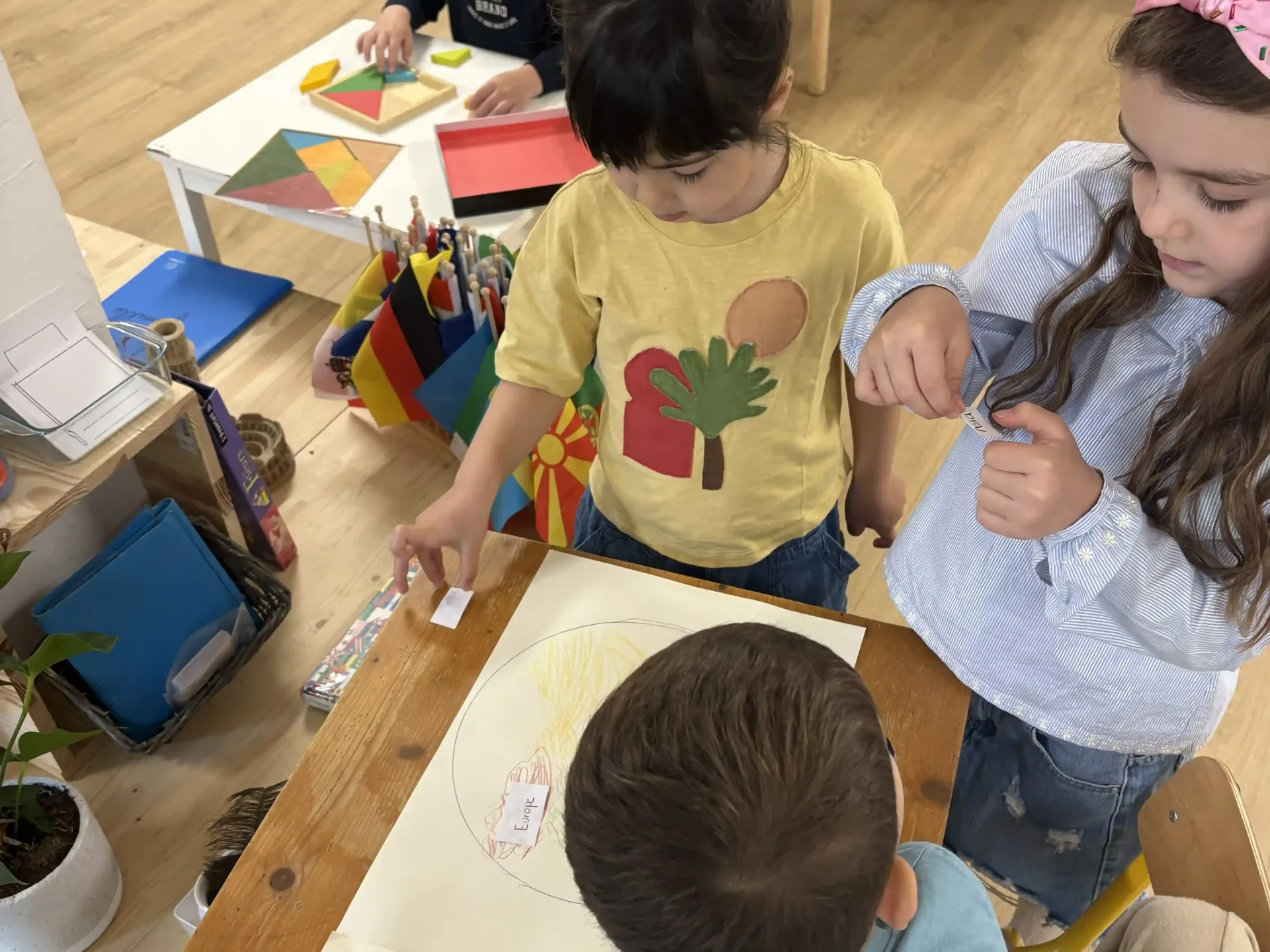
"Good morning! How are you today?" Greetings, the day's ritual, the calendar — all in English. The child hears, replies, absorbs.
Carolina or Monika move around the class, present materials in English and chat naturally with the children.
When ready, the child moves on to picture books and first readers in English. No pressure — curiosity does the work.
Real conversations emerge: "Can I have the apple please?" Vocabulary grows in context.
At the museum, on the farm, at the library, both languages coexist. Children switch effortlessly.
Many parents tell us their child sings in English, asks for an English book, or drops in a few spontaneous words.
Learning a second language from an early age supports executive functions — attention, flexibility, working memory. Early bilingual children often show stronger capacities for adaptation and abstraction.
Montessori pedagogy, international by nature, lends itself especially well to bilingual immersion: hands-on materials are understandable in any language, and teachers address each child individually within their zone of proximal development.
In practice, bilingual immersion helps every child develop:
English isn't taught as a subject — it's lived every day. A native English-speaking teacher or assistant is present in the classroom and works with the children across every activity and every moment of the day. Children learn English the way they learn a mother tongue: through use.
Absolutely. Most of our pupils arrive with no English at all. Progressive immersion in class is designed exactly for that: children first understand, then start speaking naturally, usually within a few months.
No. Extensive research shows that early second-language exposure strengthens executive functions and does not hinder the mother tongue. French follows its normal rhythm — bilingualism is added, it doesn't replace anything.
Dig deeper
A 15-minute chat with our head teacher, no strings attached. You'll leave with a clear picture of our approach and the next steps.
Language immersion at Junior Academy follows the "one person, one language" principle. A French-speaking teacher and an English-speaking teacher are simultaneously present in each environment, each addressing the children exclusively in their mother tongue. This allows the child's brain to associate each language with a real person and to switch between languages without mental translation.
Exposure to English represents about half of the school day, through Montessori activities, meals, breaks and the morning and afternoon rituals. There are no separate English lessons: the language becomes the living language of the classroom, carried by adults who speak it naturally.
This approach draws on neuroscience research identifying an optimal window for language acquisition before age 7. On leaving our school, children can hold a fluent conversation in English, read age-appropriate books and write short texts.
No. The vast majority of our families are French-speaking. The school setting alone is enough to build genuine bilingualism, with no extra effort required at home.
No. English is the language of the classroom for half of the time, carried by a native English-speaking adult. It's not a subject — it's a living language.