
Individual weekly plan
Each child agrees a weekly plan with the teacher. They learn to organise their time, set goals and assess their progress.
Explorers' Community
At six, the child becomes a reasoning mind: they seek to understand the world, connect ideas, develop moral awareness and critical thinking. Our elementary class welcomes them into a structured, demanding and deeply respectful bilingual environment.
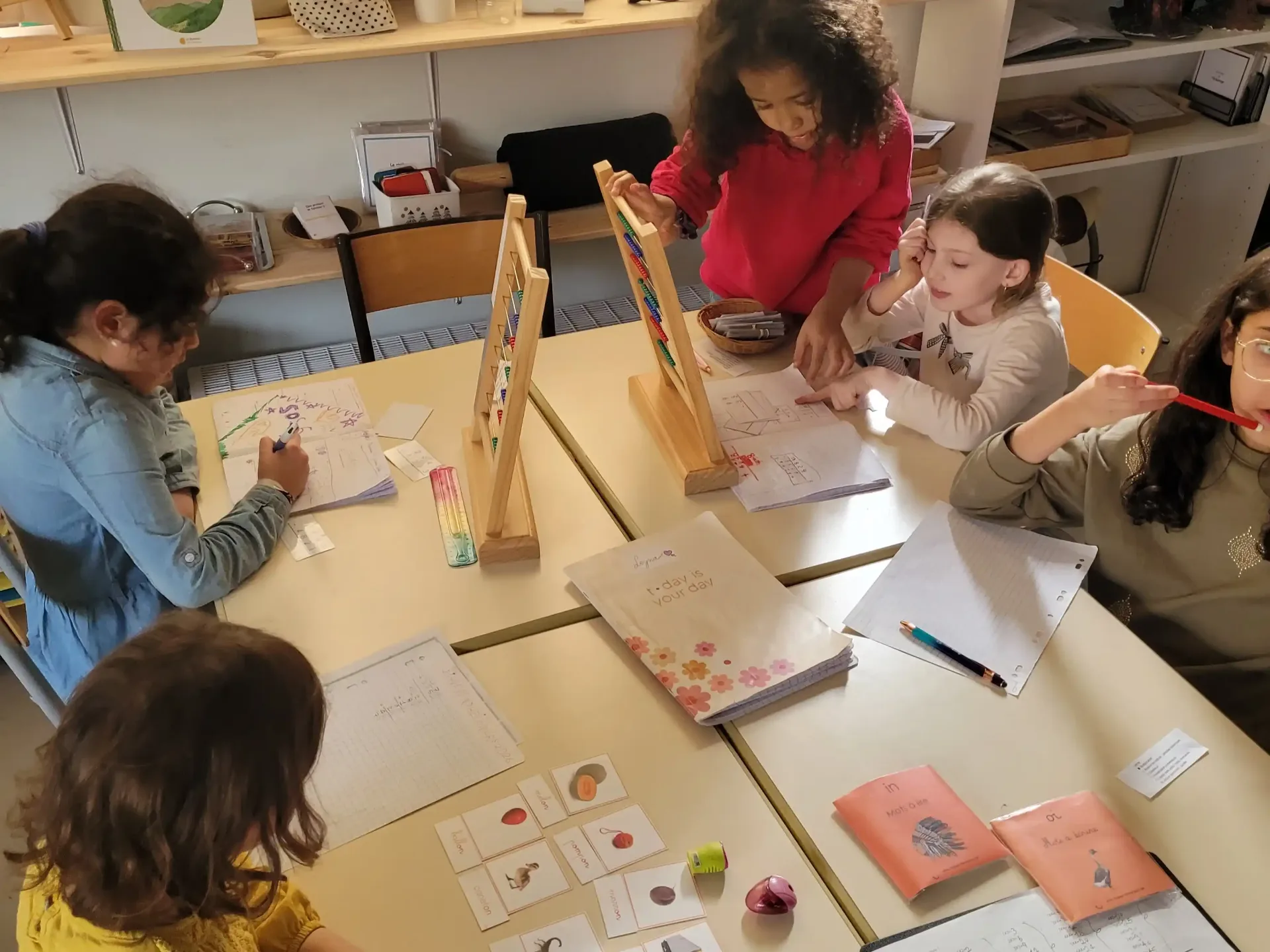
Each child agrees a weekly plan with the teacher. They learn to organise their time, set goals and assess their progress.
Maths, grammar and science concepts are first handled with materials, then internalised and symbolised.
The Great Stories (origins of the universe, of life, of humankind) open up multi-week projects that cut across subjects.
The 6-12 share one classroom. Older children pass on and consolidate; younger ones learn by observing and imitating.
Library, museum, farm, nature outings: the class regularly goes out to anchor learning in the real world.
English isn't taught — it's lived. Children gradually access reading in English and discover English-language literature.
We support children to become:
Montessori 6-12 doesn't only prepare children for academic success: it prepares them for life.
It's an approach developed by Maria Montessori (Italian physician, 1870-1952) based on observing the child and respecting their rhythm. The child freely chooses their activity in a carefully prepared environment, handles concrete sensorial materials, and moves gradually from sensory experience to abstract thinking. The teacher observes and guides — never imposes.
Yes and no. The educational objectives of the French national curriculum are fully respected, but not the detailed programme itself. We follow the Montessori curriculum, delivered by our trained teachers and assistants.
The aim of Montessori isn't only to prepare a child for the next school — it's to prepare them for life. Our pupils go on to state, private or international schools. They leave with valuable skills: autonomy, organisation, self-confidence, intellectual curiosity and the ability to learn on their own. These qualities usually make the transition to a new school setting smooth.
Multi-age classes (3-6 and 6-12) encourage cooperation, mutual help and healthy emulation. Younger children learn by watching the older ones; older children consolidate their knowledge by passing it on. It's a cornerstone of Montessori education.
Dig deeper
A 15-minute chat with our head teacher, no strings attached. You'll leave with a clear picture of our approach and the next steps.
The 6-12 environment, known as the Explorers' Community, matches the age of reason in the child. Montessori materials become more abstract, projects grow larger, and teaching follows the Great Lessons that give meaning to learning: origin of the universe, appearance of life, prehistory, invention of writing, invention of mathematics.
The programme covers the competencies of the French Éducation nationale cycles 2 and 3: French, mathematics, science, history and geography, arts, physical education. Outings (library, Lyon museums, farm, mountain) extend the classroom work and anchor learning in the real world.
English remains carried daily by an English-speaking assistant. Children read books in English, write texts and give presentations in both languages. On leaving Year 6, they move on to a mainstream or international collège with solid foundations.